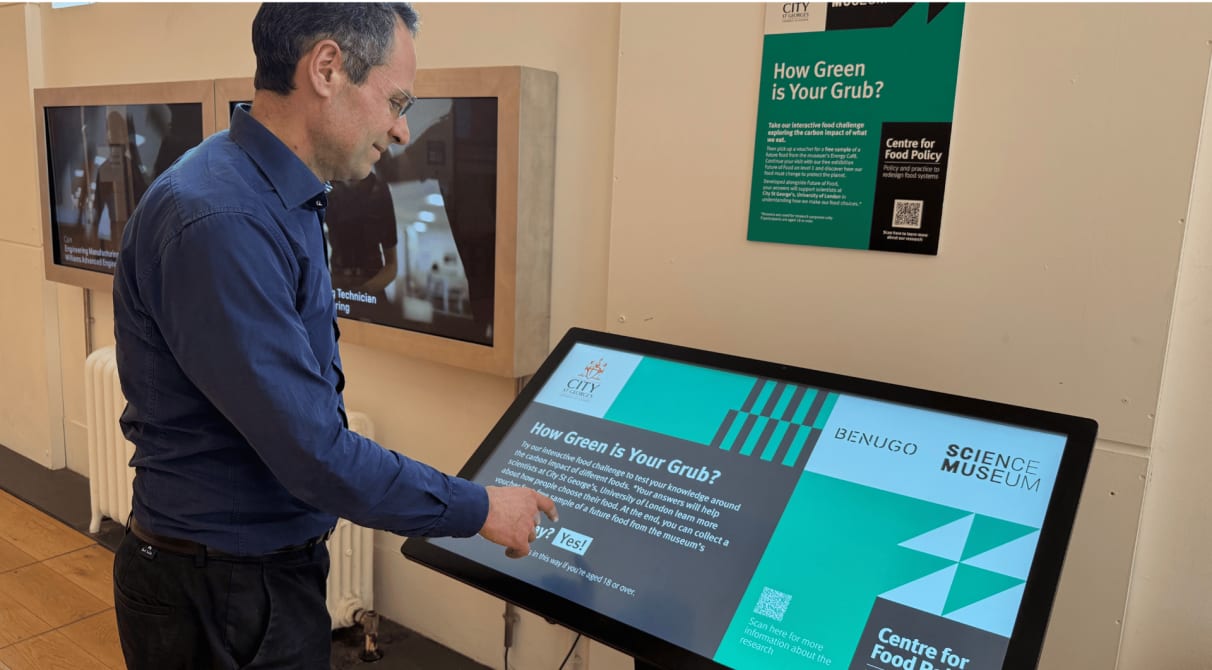
Researchers from City St George’s, University of London and Benugo have been working with the Science Museum on their Future of Food exhibition, which is due to run until 1 September 2026.
The team, which involves academics from the Centre for Food Policy and Department of Psychology, have developed a touchscreen quiz around sustainability as an exhibition tie-in.
The ‘How Green is your Grub?’ interactive food challenge aims to test visitors’ knowledge around the carbon impact of different foods. The answers will help scientists at City St George’s learn more about how people choose their food, and players can also collect a voucher for a free sample of an insect-based ‘future food’ supplied by Altimate Nutrition. The research team includes Professor Katy Tapper, Dr Christian Reynolds, Dr Datin Shah and Dr Carsten Allefeld.
Overall, the Future of Food exhibition provides a glimpse into the future of food in an illuminating way, and enables people to explore how science is creating more sustainable ways of producing and consuming food.
Through thought-provoking objects, hands-on interactive exhibits and compelling digital experiences, visitors will learn about food production and how scientific advances in ecology and biotechnology could change food in the future.
With more than 100 historic and contemporary objects, from Mendel’s microscope to McNuggets®, cricket burgers to cell-grown salmon, and 3,500-year-old bread to the first Quorn burger, the fascinating exhibition asks visitors what future they want for their plates and the planet.
Katy Tapper, Professor of Psychology in the Department of Psychology and Centre for Food Policy at City St George’s, said:
“This project offers an exciting opportunity to showcase our research on sustainable food systems and the psychology of food choice to a wide public audience. By collaborating with the Science Museum, Benugo and the UK Edible Insect Association, we have developed an interactive feature for the upcoming Future of Food exhibition. Visitors will engage with evidence from City St George’s researchers on sustainability and food choice, and contribute to ongoing research in this area. The exhibition not only highlights the importance of sustainable eating but also encourages people to reflect on their own food choices beyond the museum walls.”
Dr Geoffrey Knott, Chair & Novel Foods Lead of the UK Edible Insect Association, said:
“We are excited to be working with Prof Tapper and the team at City St George’s, and we have already developed a follow up piece of joint research into consumer reactions to products containing edible insects. Dr Glyn Morgan, Head of Collections at the Science Museum, got it absolutely right on the BBC Today Programme when he suggested that products containing edible insects have an important role to provide consumers with more sustainable options to include in their weekly food shop. Especially when they are as delicious as those made by UKEIA members such as Altimate Nutrition.”
The project is funded by the Consumer Lab (Biotechnology and Biological Sciences Research Council), with support from the Department for Environment, Food and Rural Affairs (Defra), Innovate UK and the Medical Research Council (MRC). It is also funded via HEIF Funding for Knowledge Exchange, a fund dedicated to enabling the transformation of research outputs into products, services, models and tools for the benefit of non-academic users.